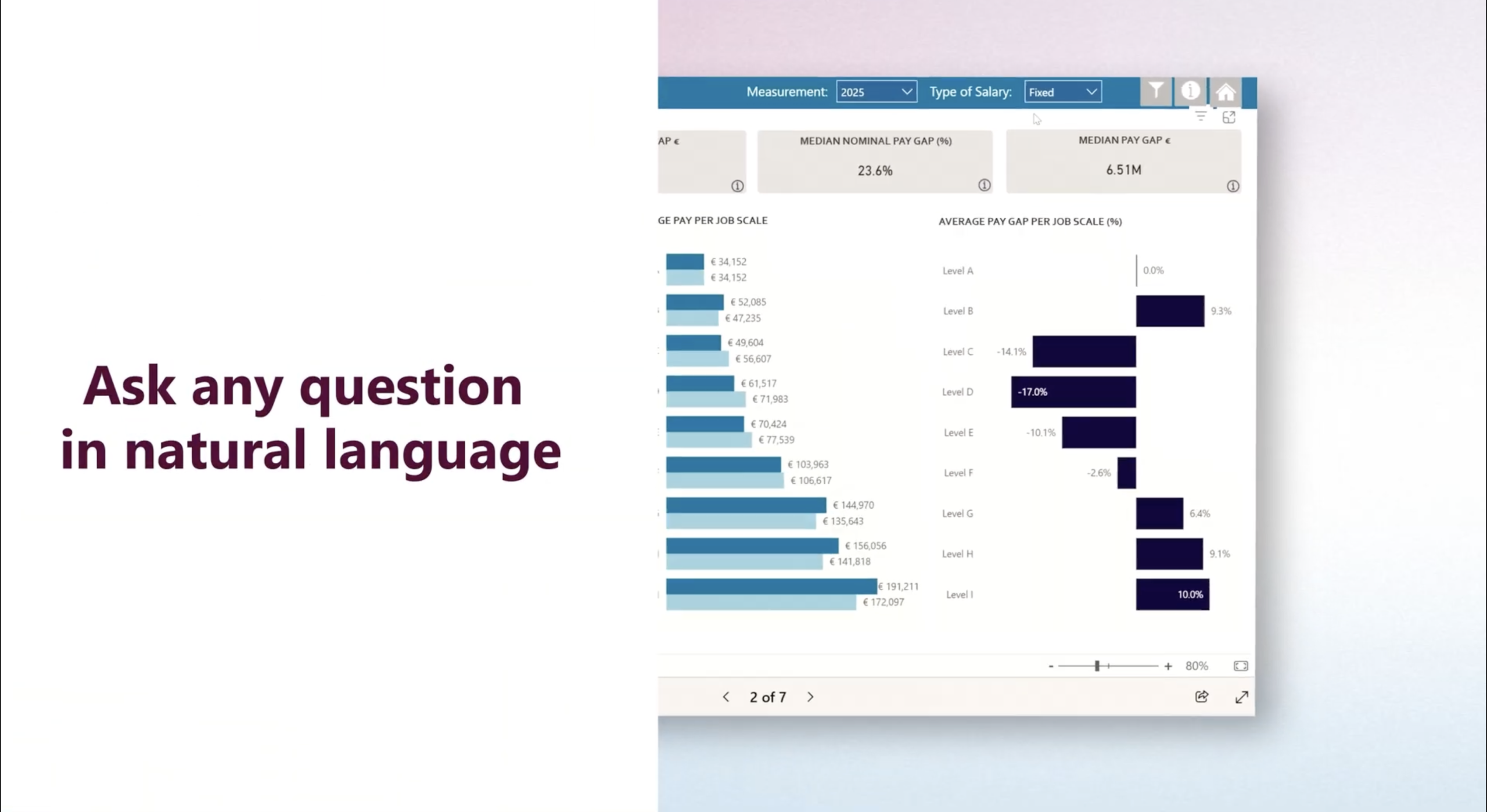
At Highberg, we developed Heidi, a Power BI analysis agent that changes how users interact with data. Instead of navigating complex dashboards, users can ask an analytical question and receive a clear, business-oriented answer.
Behind this is a structured flow of components that guide each step from question to insight. Rather than relying on a single step, the system follows a reasoning process that interprets user intent, determines an appropriate analytical approach, executes queries on the underlying data model, and validates the outcome before presenting it. This setup helps maintain consistency and reduces the likelihood of incorrect or misleading results.
A key aspect of Heidi is that it does not rely solely on the Power BI semantic model. Each report is supplemented with additional business context, including descriptions of what the report represents, commonly used definitions, and agreed-upon calculation methods for key measures. For instance, if a metric such as “margin” follows a specific formula, that definition is explicitly captured and consistently applied.
When user questions are ambiguous, the agent can fall back on predefined preferred metrics, helping ensure that answers remain aligned with internal conventions. This combination of semantic structure and contextual knowledge allows the system to produce outputs that are not only technically correct, but also meaningful within the intended business context.
Overall, the approach focuses on making data more accessible while maintaining control over how it is interpreted and presented.
Leave a Reply